
On this page
- Governance in Medicines Advice (MA) Services
- Purpose of assessing service outputs
- Identifying Medicines Advice (MA) outputs
- Training available to assess completed enquiries
- Aspects of a completed enquiry to assess
- Where assessments can be used
- Deciding how many enquiries to assess
- Tips when assessing completed enquiries
- Criteria for grading answers to enquiries with RAG rating
Governance in Medicines Advice (MA) Services
Governance in healthcare is referred to as clinical governance, “a system through which NHS organisations are accountable for continuously improving the quality of their services and safeguarding high standards of care by creating an environment in which excellence in clinical care will flourish”.
It involves monitoring systems and processes to provide assurance of patient safety and quality of care across the organisation.
MA service managers need to provide assurance that the MA service is delivering safe, high-quality care. This can be done through audits, by monitoring outputs, gathering staff feedback and user satisfaction.
Purpose of assessing service outputs
Understanding and measuring outputs is critical to determining process or project effectiveness, tracking progress towards objectives, and providing accountability and transparency.
Areas of good practice will be highlighted and can be shared.
- The outcomes are what the service wants or needs to achieve.
- The outputs are the actions or items that contribute to achieving an outcome.
In other words, outcomes are the results, and outputs are the activities that support the desired results.
Identifying Medicines Advice (MA) outputs
These are provided through the UKMi Quality Review Self-Assessment and the UKMi Key Performance Indicators (KPIs). Staff responsible for running an MI/MA service should consider these tools when deciding which service outputs to consider as a priority.
There may be additional service outputs to measure as agreed with local stakeholders.
Recommendations arising from an assessment can only serve to ensure standards are maintained across the UKMi network and should not be viewed as negative or critical. There is no pass or fail.
This document focuses on the assessment of completed enquiries which can contribute to the overall assessment of the enquiry answering service and provide learning for staff.
Training available to assess completed enquiries
All staff involved in assessing enquiries should be trained to assess enquiries and give constructive feedback.
Training to assess enquiries is accessible through:
- UKMi National MI Training Course (runs every November)
- Trained local MI/MA managers
- Lead MI/MA service in area (where available and offered)
Training on how to give feedback is accessible through:
- Local Trust Educational and Training departments and/or staff management courses.
- NHS Elect courses (where available)
Aspects of a completed enquiry to assess
The outcomes of assessing the completed enquiries are to:
- Highlight good practice when taking in, researching and answering questions about medicines.
- Ensure that accurate information and advice is provided to the user in a timely manner based on clinical need.
- Provide feedback to staff in training, during appraisals or at 1-2-1.
- Assist in the decision to remove the need for authorisation from staff in training.
Consider your enquiry answering process to identify the outputs to assess. For example:
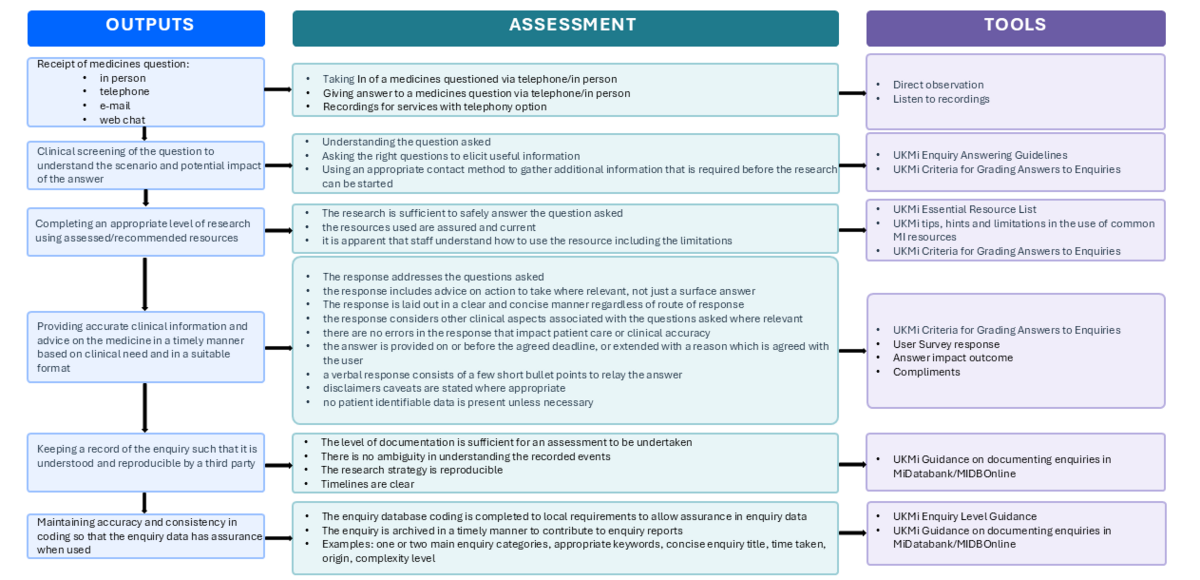
Where assessments can be used
Whenever confidence is required in answering questions about medicines, an assessment may be appropriate. For example:
- Staff appraisal
- Staff 1-2-1 (direct lines)
- Trainee feedback
- Deciding when to remove the requirement for all enquiries to be second checked
- Practice sharing and learning
- Service audit
The decision to collect data across several MA services for benchmarking should be agreed within an organisation or across an area. Data is currently not collected nationally by UKMi.
The methods that follow are examples of practice and can be adopted and tailored to local need and agreement.
| Type of scenario | Method | Who is involved | ||||||||||||||||||||||
|---|---|---|---|---|---|---|---|---|---|---|---|---|---|---|---|---|---|---|---|---|---|---|---|---|
| Appraisal or 1-2-1 |
|
|
||||||||||||||||||||||
| Rotational trainee feedback |
|
|
||||||||||||||||||||||
| Before removing need for all enquiries to be second checked |
|
|
||||||||||||||||||||||
| Sharing useful enquiry |
|
|
||||||||||||||||||||||
| Practice sharing |
|
|
||||||||||||||||||||||
| MI/MA quality reports |
|
|
||||||||||||||||||||||
| Lone MI/MA staff |
Suggestion 1:
Suggestion 2:
|
|
||||||||||||||||||||||
| Peer review for benchmarking (multiple services) |
|
|
||||||||||||||||||||||
| MI/MA service quality review self-assessment |
|
|
Deciding how many enquiries to assess
Identifying the number of enquiries to assess for each scenario will be based on the number of MI/MA staff, local enquiry workload, the individual being assessed and the purpose of the assessment.
For example:
- A lone MI/MA worker may benefit from external assessment of one enquiry per month.
- Staff in training may sometimes have significant MI/MA experience allowing for fewer enquiries to be assessed before removing authorisation, e.g. new staff joining from another MI/MA service.
- Staff in training may sometimes lack confidence in answering enquiries and require more enquiries to be assessed for evidence sign off, e.g. trainee pharmacists, student pharmacy technicians.
- Enquiry workload will vary from MI/MA service to MI/MA service, as will the range of enquiry types so assessing one completed enquiry per person per quarter may not capture the range or complexity of enquiries completed.
- For benchmarking, a proportion of the completed enquiries each year may be the preferred option (the following suggestion is based on the ‘Guidance for the use of user surveys in UKMi Services’ and provides range in the last column to sample over a period of time):
| Number of completed enquiries per month | % of completed enquiries to assess | Number of enquiry assessments to complete per month* |
|---|---|---|
| 0-100 | 5 | 1-5 |
| 100-200 | 4 | 4-8 |
| 200-400 | 3 | 6-12 |
| 400+ | 2 | 12-15 |
*Decide the number and time period locally based on staffing capacity, experience and number of enquiries completed
Tips when assessing completed enquiries
- It is a learning process and not a method to look for faults.
- People will make mistakes but how significant are they? How big a risk does the mistake pose?
- Take a team approach – agree a method for assessing that works best for everyone.
- Consider protected time to assess a sample of completed enquiries on a regular basis.
- Provide feedback that enhances learning and understanding.
- In the event of identifying a near miss or error, agree to complete an anonymous ALERT form so that the network can learn and reduce the risk of recurrence.
- Trainees may require more observation of calls initially (recorded or live) compared to experienced staff.
- User response may trigger the need to assess a recorded call or review a completed enquiry.
- Things to consider when assessing call interactions:
- active listening by staff
- attention to user responses
- clarity in communication
- patience with user
- empathy demonstration (where required)
- positive attitude
- negotiation of deadline based on clinical urgency for answer
- non-judgemental.
- Staff assessing enquiries and providing feedback should be trained in both aspects.
Criteria for grading answers to enquiries with RAG rating
The UKMi Criteria for grading answers to enquiries was produced in 2010. It has been amended below for the purposes of this document to reflect current practice. The scoring criteria is no longer deemed useful for enquiry assessment.
The comments relating to each aspect are more useful to service and staff development. These comments can be given a subjective rating of red = poor, amber = OK, and green = good. Please see the attached supplementary Excel spreadsheet to record the ratings for each aspect of the completed enquiry.
The table provides examples of points to consider, there may be additional points depending on local practice. The overall opinion for RAG should be given based on the points below. The bullet points do not map to any scoring system and should not be used in this manner.
| Aspect of completed enquiry | Considerations for a good rating | Considerations for an OK rating | Considerations for a poor rating | ||||||||||||||||||||||||||||||||||||||||
|---|---|---|---|---|---|---|---|---|---|---|---|---|---|---|---|---|---|---|---|---|---|---|---|---|---|---|---|---|---|---|---|---|---|---|---|---|---|---|---|---|---|---|---|
|
Documentation (Standards are the same for all levels of complexity) |
Record is complete i.e.
|
Record is complete to the extent that
|
There are key omissions i.e.
|
||||||||||||||||||||||||||||||||||||||||
| Analysis (As above) |
The form shows evidence that the question has been fully understood, and that sufficient, relevant background information has been obtained. | Some relevant information (useful but not essential) is missing which may have assisted in providing a more comprehensive answer. Implications of enquiry not fully understood. | Question does not appear to have been understood, no background information. Omissions in enquiry. | ||||||||||||||||||||||||||||||||||||||||
| Coverage (Standards depend on level of complexity) |
Level 1 – answered using data from one or two standard sources. Does not require MA trained staff to research and answer. | ||||||||||||||||||||||||||||||||||||||||||
| Shows evidence of use of relevant authoritative resources or (if appropriate) accurate and up-to-date personal knowledge. | Accurate but not comprehensive personal knowledge used. Answer might have been improved by use of additional/alternative resources. | Inaccurate personal knowledge used. Answer not supported by relevant resources. | |||||||||||||||||||||||||||||||||||||||||
| Level 2 – requiring the use of multiple and more specialist sources where the available evidence provides a reasonably clear answer or course of action. Requires MA trained staff to research, interpret and answer. | |||||||||||||||||||||||||||||||||||||||||||
| Relevant authoritative general resources have been used. In addition, databases, in-house files and more specialised resources have been used where appropriate. It is unlikely further useful information would be gained by further resource use. | There is evidence appropriate resources have been used but omissions are apparent, and/or resources have not been used in a systematic fashion (i.e. authoritative references first, then more specialised resources if needed). Useful information may have been missed. | Key texts appear to have been omitted. It is likely that important information has been missed. | |||||||||||||||||||||||||||||||||||||||||
| Level 3 – in the absence of a clear answer or course of action from available sources. Requires MA staff to interpret, apply and involve professional judgement to provide advice to the enquirer. | |||||||||||||||||||||||||||||||||||||||||||
| As for level 2. In addition, where necessary, a thorough search of the literature has been conducted. | As for level 2, and/or incomplete use of bibliographic databases where use of these was necessary. | Key resources omitted. It is likely that important information was missed. | |||||||||||||||||||||||||||||||||||||||||
| Answer (Standards depend on level of complexity) |
Level 1 – answered using data from one or two standard sources. Does not require MA trained staff to research and answer. | ||||||||||||||||||||||||||||||||||||||||||
| Evidence that the answer is accurate and based on comprehensive knowledge supported by appropriate resources where necessary. The answer has been communicated at a suitable level (use of language) and by an appropriate method. |
The answer appears to be accurate and supported, but there may have been some problems, e.g. as follows:
|
The answer is inaccurate, or the enquiry has not been answered at all, and/or there has been a serious failure in communication. | |||||||||||||||||||||||||||||||||||||||||
| Levels 2 and 3 – requiring the use of multiple and more specialist sources where the available evidence provides a reasonably clear answer or course of action. Requires MA trained staff to research, interpret and answer. Elements of professional judgement used for advice. | |||||||||||||||||||||||||||||||||||||||||||
|
Evidence that comprehensive knowledge and thorough consideration of the issues have been used. The information has been evaluated in a logical fashion. Skill in interpreting the information and application to individual circumstances are demonstrated. Calculations are correct. The answer has been communicated at a suitable level (use of language) and by an appropriate method. Sound professional judgement leading to advice which would be agreeable with most peers. |
Accurate information has been supplied but there are deficiencies e.g. in one or more of the following areas:
Advice based on professional judgement may not agree with most peers but is sound. |
The answer is inaccurate, or the enquiry has not been answered at all, and/or there has been a serious failure in communication. | |||||||||||||||||||||||||||||||||||||||||
Enquiry assessment tool
Last Reviewed: March 2024
